

What Is a Neocloud? Sovereign GPU Cloud, Explained
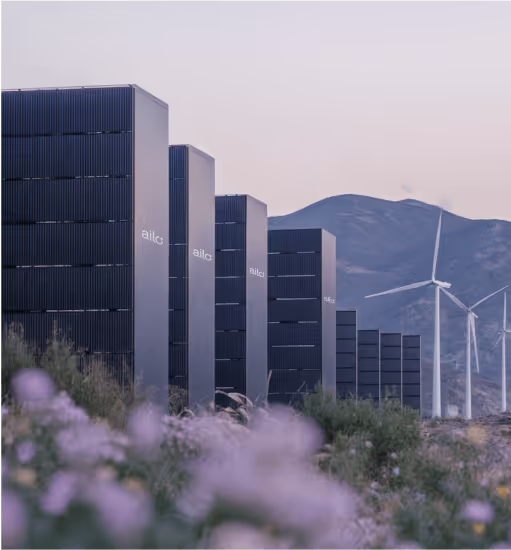
- Neoclouds specialize in GPU compute; hyperscalers spread GPU capacity across a much larger, general-purpose product line.
- The neocloud market grew directly out of GPU scarcity — when hyperscaler waitlists for the newest NVIDIA hardware stretched to months, specialist providers filled the gap.
- Data sovereignty is becoming a second axis of competition inside the neocloud category itself, not just a hyperscaler-vs-neocloud question.
- Choosing a provider is a trade-off between raw scale, price, and compliance guarantees — few providers offer all three.
What is a neocloud?
"Neocloud" is the term the AI infrastructure industry uses for a new generation of cloud providers built around one product: GPU compute. Where a traditional hyperscaler sells storage, databases, serverless functions, and hundreds of other services with GPU instances as one line item among many, a neocloud's entire business is provisioning GPU clusters for AI training and inference.
The category emerged because demand for AI compute — driven by large language model training and, increasingly, inference at scale — began outpacing what the big three cloud providers could allocate to any single customer. Waitlists for the newest GPU generations at hyperscalers regularly stretched for months. Neoclouds filled that gap by building GPU-dense data centers and selling access directly, without the surrounding general-purpose platform.
Neocloud vs. hyperscaler vs. sovereign neocloud
These three categories increasingly compete for the same buyer, but they are not the same thing:
| Hyperscaler | Neocloud | Sovereign neocloud | |
|---|---|---|---|
| Core product | Hundreds of general-purpose services | GPU compute, specialized | GPU compute + guaranteed data residency |
| Hardware access | Shared capacity, often waitlisted | Dedicated GPU-dense clusters | Dedicated GPU-dense clusters |
| Pricing model | Complex, bundled, usage-based | Simpler per-GPU / per-hour pricing | Simpler per-GPU pricing + compliance tier |
| Data jurisdiction | Often multi-region by default | Varies by provider | Contractually guaranteed, single jurisdiction |
| Best fit | General workloads, existing cloud commitments | Cost- and speed-sensitive AI training/inference | Regulated industries, government, cross-border data rules |
Why data sovereignty is becoming the next dividing line
Most coverage of the neocloud category stops at hardware and pricing. That misses where the market is actually heading. As AI workloads move from experimentation into production inside banks, hospitals, telecoms, and public sector bodies, the question stops being only "how fast and how cheap" and becomes "where does this data actually live, and under whose law."
Regulations like GDPR and the EU AI Act don't just ask for encryption — they ask for provable answers about where data is processed, who can be legally compelled to access it, and whether a foreign government's laws (like the US CLOUD Act) could reach it regardless of where the servers physically sit. A GPU cluster in Europe, run by a provider legally headquartered and governed elsewhere, doesn't fully answer that question. This is the gap sovereign neoclouds are built to close: the same GPU-specialist economics as any neocloud, combined with contractual, jurisdictional, and operational guarantees about where data stays and who governs it.
For banking, healthcare, industrial/energy, and public sector buyers specifically, this isn't a nice-to-have — it's frequently a procurement requirement that rules out both hyperscalers and most GPU-only neoclouds before performance or price ever enter the conversation.
How to choose a neocloud provider
The right provider depends on what you're optimizing for. Questions worth asking any neocloud before signing:
- Hardware availability — which GPU generations are actually available today, not on a waitlist?
- Pricing structure — on-demand, reserved, or hybrid, and how does it compare once you include data egress and storage?
- Data residency — can they contractually guarantee which country your data is processed and stored in, and who can legally access it?
- Regulatory fit — do they already serve your industry's compliance requirements (GDPR, sector-specific rules), or would you be the first regulated customer testing that?
- Energy sourcing — GPU clusters are power-intensive; is the provider's energy sustainably sourced, and does that show up in your own ESG reporting?
- Scalability path — can they grow with you from a pilot cluster to production scale without a re-architecture or a provider switch?
Where neoclouds fit today
The neocloud market now spans a few distinct groups rather than one homogeneous category:
- Large-scale US GPU specialists — providers that scaled rapidly on public and private capital to become major NVIDIA hardware partners, competing primarily on raw GPU supply and price.
- Regional and workload-specific providers — smaller neoclouds focused on a specific geography, GPU generation, or workload type (training vs. inference).
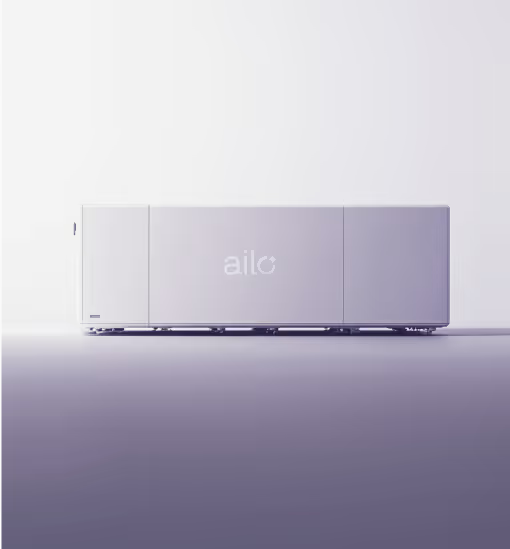
- Sovereign neoclouds — a newer group, including Ailo, built around data residency and regulatory fit as a first-class feature rather than an afterthought, typically paired with modular, energy-efficient data center infrastructure and long-term sustainable power sourcing.
Frequently asked questions
What is a neocloud in simple terms?
A neocloud is a cloud provider built specifically to rent out GPU compute for AI training and inference, rather than offering the full general-purpose product catalog of a hyperscaler. Neoclouds typically offer newer GPU hardware, simpler pricing, and faster provisioning.
What is the difference between a neocloud and a hyperscaler?
Hyperscalers run enormous, general-purpose platforms with GPU capacity as one product among many, often GPU-constrained and priced at a premium. Neoclouds specialize in GPU compute alone, which typically means more available capacity, simpler per-GPU pricing, and faster access to the newest hardware generations.
What is a sovereign neocloud?
A sovereign neocloud is a neocloud that additionally guarantees where data is stored and processed, who can access it, and under which legal jurisdiction it operates — built to satisfy data residency rules like GDPR and the EU AI Act, and the compliance requirements of regulated sectors such as banking, healthcare, and government.
Are neoclouds cheaper than AWS or Azure for GPU workloads?
Often, yes, for GPU-specific workloads — neoclouds generally avoid the bundled overhead of a general-purpose cloud platform and price GPU access more directly, though exact savings depend on hardware generation, contract length, and region.
Who are the main neocloud companies?
The category spans large US GPU specialists that scaled rapidly on public and private capital, smaller regional and workload-specific providers, and a newer group of sovereign neoclouds that compete on data residency and compliance rather than raw scale alone.
Building on sovereign, sustainable GPU infrastructure?
Explore Ailo's GPU-as-a-Service